
Before You Go
- Confirm passport validity and entry requirements.
- Check whether a tourist visa is required.
- Keep digital copies of important documents.
- Consider purchasing travel insurance.
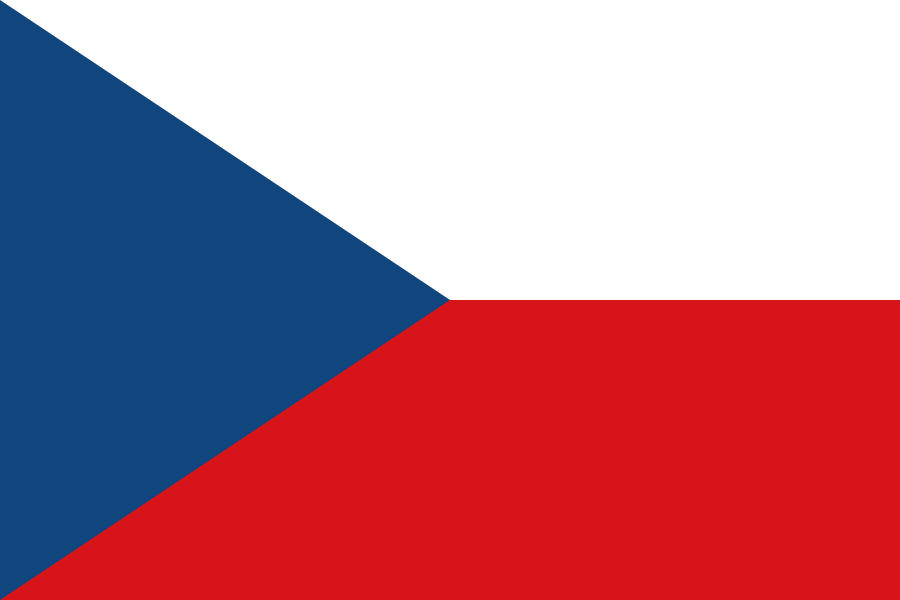
Prague
Czech Koruna (CZK)
Czech
May–Sep
CET (UTC+1) / CEST (UTC+2)
Welcome to Czechia, a Central European country where medieval castles, cobblestone streets, and world-famous beer create an atmosphere straight out of a storybook. Prague, the capital, enchants visitors with its Gothic spires, astronomical clock, and the iconic Charles Bridge spanning the Vltava River. Český Krumlov's fairy-tale old town, wrapped around a bend in the river, feels remarkably preserved from centuries past. Czechia's countryside is dotted with dramatic castles, including Karlštejn, perched dramatically atop a forested hill. The country is renowned for its beer culture, producing some of the finest and oldest brewing traditions in the world. Moravia's rolling vineyards and thermal spa towns offer a quieter, scenic alternative to the bustling capital. Bohemian crystal and marionette craftsmanship reflect centuries of artistic tradition still practiced today. Czechia invites travelers to explore a country where history feels alive on every cobblestone street.

No API URL found for post ID 140474.
Helpful information to consider before and during your visit.
Discover some of Czechia's most popular flavors, traditional dishes and memorable local treats during your visit.
Svíčková is a signature Czechia specialty known for its distinctive local ingredients, seasoning and traditional preparation.
This popular Czechia dish brings together familiar regional flavors and is commonly enjoyed in homes, markets or local restaurants.
A well-loved part of Czechia cuisine, Guláš reflects the country's culinary traditions and locally available ingredients.
Smažený Sýr is a comforting regional favorite, prepared in styles that may vary between families, cities and different parts of Czechia.
Visitors often seek out Kulajda for an authentic taste of Czechia's everyday cooking and food culture.
This traditional favorite highlights the bold, savory or gently spiced flavors associated with cooking in Czechia.
Chlebíčky is widely recognized in Czechia and is often served at casual meals, celebrations or community gatherings.
A memorable choice for travelers, Koláče offers a flavorful introduction to the ingredients and techniques used across Czechia.
This classic food is an important part of Czechia's culinary identity and is best sampled freshly prepared.
Czechia, also known as the Czech Republic, is home to more than 2,000 castles and châteaux, giving it one of the highest concentrations of historic castles in Europe. Many of these fortresses date back to the Middle Ages and overlook picturesque towns, forests, and rolling countryside. The country's capital, Prague, is often called the "City of a Hundred Spires," although it actually boasts hundreds more church towers, domes, and historic buildings that have earned it UNESCO World Heritage status.
One of Czechia's most fascinating natural attractions is the Moravian Karst, an extensive system of caves, underground rivers, and dramatic limestone formations. Among its highlights is the Macocha Abyss, a spectacular sinkhole more than 450 feet deep that has inspired local legends for centuries. Czechia is also famous for its spa towns, particularly Karlovy Vary, where visitors have sought the healing properties of mineral springs for over 650 years. The country also has one of the world's oldest astronomical clocks, installed in Prague's Old Town Square in 1410, and it continues to delight crowds every hour.
Beer has long been an important part of Czech culture, and the country consistently ranks among the world's highest in beer consumption per capita. The city of Plzeň gave the world the famous Pilsner style of lager, now brewed across the globe. Czechia is also the birthplace of the word "robot," introduced by playwright Karel Čapek in his 1920 science fiction play R.U.R. Combining medieval architecture, scientific innovation, natural beauty, and rich cultural traditions, Czechia offers far more than many visitors expect.
Another little-known fact is that Albanians have a unique cultural tradition called "Besa," meaning "to keep one's promise." This centuries-old code of honor became internationally recognized during World War II when Albania was one of the few European countries where the Jewish population actually increased because local families risked their lives to shelter refugees. Albania also boasts the stunning Blue Eye (Syri i Kaltër), a natural spring with crystal-clear turquoise water whose exact depth remains unknown despite multiple explorations.
Finally, Albania enjoys more than 300 sunny days each year, rivaling many Mediterranean destinations. The country is also famous for its "sworn virgins"—a centuries-old tradition in remote mountain villages where women could legally assume male social roles by taking a lifelong vow of celibacy, preserving family inheritance and leadership in the absence of male heirs.