Blahface.com Uniting People Online

Capital

Manila

Currency

Philippine Peso (PHP)

Language

Filipino, English

Best Time

Dec–Feb

Time Zone

PHT (UTC+8)

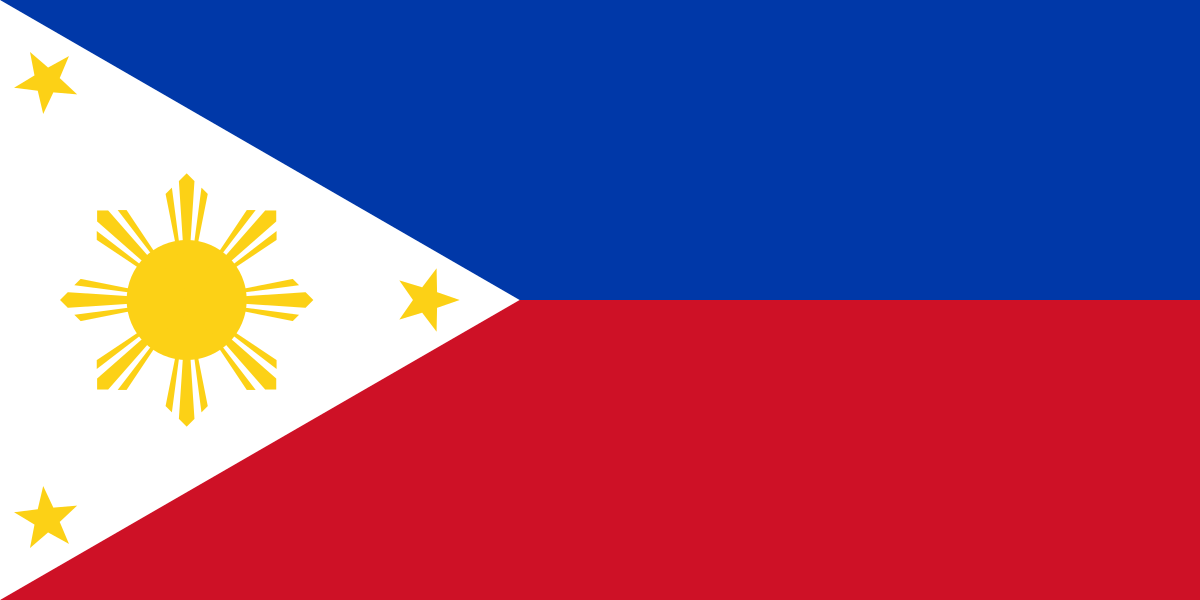
Flag of Philippines
Welcome to Philippines

Philippines' Island-Studded Paradise

Welcome to the Philippines, a Southeast Asian archipelago of over 7,000 islands, offering some of the most stunning beaches on Earth. Palawan's El Nido and Coron reveal dramatic limestone cliffs rising from turquoise lagoons and hidden beaches. Manila, the capital, blends Spanish colonial history with a vibrant, bustling modern energy. The rice terraces of Banaue, carved into mountainsides over two thousand years ago, remain a breathtaking feat of ancient engineering. Chocolate Hills in Bohol create a surreal, undulating landscape found nowhere else on Earth. World-class diving throughout the islands reveals vibrant coral reefs and diverse marine life. Filipino hospitality, warm and welcoming, makes visitors feel instantly at home throughout the islands. The Philippines invites travelers to discover an island paradise of extraordinary natural beauty.

Popular City

Manila

Manila’s Intramuros, the old walled Spanish colonial city, holds Fort Santiago and the baroque San Agustin Church, a UNESCO World Heritage site with centuries of history within its stone walls. Rizal Park honors the national hero Jose Rizal with monuments set along Manila Bay. The bay’s waterfront promenade is famous for its sunsets, drawing crowds each evening to watch the sky turn orange over the water. Binondo, one of the oldest Chinatowns in the world, offers a dense mix of temples, markets, and some of the city’s best food. The National Museum complex traces Filipino history and art, including the country’s rich indigenous and colonial-era collections. Manila’s chaotic energy and layered colonial history make it a fitting introduction to the Philippines’ more than seven thousand islands.

Travel News

No API URL found for post ID 140568.

Popular City

Cebu City

Cebu City, one of the oldest settlements in the Philippines, centers on Magellan’s Cross, planted to mark the site of the first Catholic baptism in the country in 1521. The nearby Basilica del Santo Nino houses a revered image of the Christ Child central to Filipino Catholic devotion. Fort San Pedro, a small triangular Spanish fortress, guards the old harbor and offers a compact look at the city’s colonial military history. Cebu serves as the main gateway to the central Philippines, with ferries and flights connecting to the islands of Bohol and the whale shark waters of Oslob. The city’s lechon, whole roasted pig, is considered among the best in the country and can be sampled at markets throughout the city. Cebu’s blend of colonial history and access to island-hopping makes it a key stop in the Visayas region.

Travel Tips

Helpful information to consider before and during your visit.

Before You Go

  • Confirm passport validity and entry requirements.
  • Check whether a tourist visa is required.
  • Keep digital copies of important documents.
  • Consider purchasing travel insurance.

Money & Payments

  • Review the local currency and exchange rate.
  • Carry some cash for small businesses and markets.
  • Check for international bank transaction fees.
  • Learn the country's customary tipping practices.

Stay Connected

  • Review your mobile carrier's international plan.
  • Consider purchasing a local SIM or eSIM.
  • Download maps for offline use before traveling.
  • Avoid sensitive transactions on unsecured Wi-Fi.

Transportation

  • Research public transportation before arrival.
  • Use licensed taxis or reputable rideshare services.
  • Check which side of the road vehicles use.
  • Confirm whether an international permit is needed.

Electricity

  • Check the country's voltage and outlet type.
  • Bring the correct plug adapter for your devices.
  • Use a voltage converter when required.
  • Pack a portable charger for longer excursions.

Weather & Clothing

  • Review the seasonal weather before packing.
  • Bring layers for changing temperatures.
  • Pack rain protection when appropriate.
  • Use sunscreen even on cool or cloudy days.

Food & Water

  • Research whether tap water is safe to drink.
  • Communicate food allergies clearly.
  • Try traditional dishes from reputable vendors.
  • Observe local dining customs and meal times.

Safety

  • Secure valuables in crowded tourist areas.
  • Avoid displaying large amounts of cash.
  • Share your itinerary with someone you trust.
  • Review current government travel advisories.

Language & Etiquette

  • Learn a few polite words in the local language.
  • Respect dress requirements at religious sites.
  • Ask permission before photographing people.
  • Follow local traditions, laws and social customs.

Emergency Planning

  • Save the country's emergency telephone number.
  • Locate your nearest embassy or consulate.
  • Keep medication in its original packaging.
  • Store emergency contacts offline and on paper.

Smart Packing

  • Pack comfortable shoes for walking and tours.
  • Keep essential medication in your carry-on.
  • Bring a reusable bottle where appropriate.
  • Leave room for locally purchased items.

Local Research

  • Check attraction hours and reservation policies.
  • Review national holidays and local closures.
  • Download important addresses before departure.
  • Leave flexibility for unexpected discoveries.
Important: Entry requirements, transportation rules, weather conditions and safety guidance can change. Verify important information with official sources before traveling.

Popular City

Palawan

Palawan, often ranked among the most beautiful islands in the world, centers on Puerto Princesa, gateway to the Puerto Princesa Subterranean River, a UNESCO World Heritage underground river that can be explored by boat through illuminated limestone caverns. The surrounding national park protects pristine rainforest and karst landscapes. El Nido, at the island’s northern tip, offers island-hopping tours through the Bacuit Archipelago’s turquoise lagoons and towering limestone cliffs, including the famous Big and Small Lagoons. Coron, further north, is known for wreck diving among sunken Japanese ships from World War Two alongside striking limestone lakes. Palawan’s beaches, coral reefs, and largely undeveloped interior have made it one of the most sought-after island destinations in Southeast Asia. Its combination of dramatic scenery above and below the water sets it apart even among the Philippines’ many islands.

Local Food to Try

Discover some of Philippines's most popular flavors, traditional dishes and memorable local treats during your visit.

Adobo

Adobo is a signature Philippines specialty known for its distinctive local ingredients, seasoning and traditional preparation.

Sinigang

This popular Philippines dish brings together familiar regional flavors and is commonly enjoyed in homes, markets or local restaurants.

Lechon

A well-loved part of Philippines cuisine, Lechon reflects the country's culinary traditions and locally available ingredients.

Kare-Kare

Kare-Kare is a comforting regional favorite, prepared in styles that may vary between families, cities and different parts of Philippines.

Pancit

Visitors often seek out Pancit for an authentic taste of Philippines's everyday cooking and food culture.

Lumpia

This traditional favorite highlights the bold, savory or gently spiced flavors associated with cooking in Philippines.

Sisig

Sisig is widely recognized in Philippines and is often served at casual meals, celebrations or community gatherings.

Halo-Halo

A memorable choice for travelers, Halo-Halo offers a flavorful introduction to the ingredients and techniques used across Philippines.

Bibingka

This classic food is an important part of Philippines's culinary identity and is best sampled freshly prepared.

Dining tip: Regional specialties and preparation styles vary throughout Philippines. Explore local markets, independent cafés and family-owned restaurants for an authentic taste of the destination.

Little-Known Facts

Philippines

Poland is home to the Białowieża Forest, one of the last and largest remaining fragments of the primeval forest that once covered much of Europe, and it still shelters wild European bison, the continent's heaviest land animal, which were hunted to extinction in the wild in the 1920s before being successfully reintroduced through a captive breeding program centered largely in Poland. The country is also home to the Wieliczka Salt Mine, in operation continuously since the 13th century, where miners carved entire chapels, chandeliers, and sculptures out of rock salt deep underground, some of which remain open to visitors today.

Poland's borders have shifted dramatically throughout history, and the country disappeared from the map entirely for over a century between 1795 and 1918, partitioned among Prussia, Russia, and Austria, before being reconstituted as an independent state after World War I. The Polish city of Toruń is the birthplace of astronomer Nicolaus Copernicus, whose heliocentric model of the solar system fundamentally reshaped humanity's understanding of its place in the universe.

Poland is also credited as the origin of the modern Enigma code-breaking effort, as Polish mathematicians made the first successful breaks into the German Enigma cipher machine years before British codebreakers at Bletchley Park built on their work during World War II.
Another little-known fact is that Albanians have a unique cultural tradition called "Besa," meaning "to keep one's promise." This centuries-old code of honor became internationally recognized during World War II when Albania was one of the few European countries where the Jewish population actually increased because local families risked their lives to shelter refugees. Albania also boasts the stunning Blue Eye (Syri i Kaltër), a natural spring with crystal-clear turquoise water whose exact depth remains unknown despite multiple explorations.

Finally, Albania enjoys more than 300 sunny days each year, rivaling many Mediterranean destinations. The country is also famous for its "sworn virgins"—a centuries-old tradition in remote mountain villages where women could legally assume male social roles by taking a lifelong vow of celibacy, preserving family inheritance and leadership in the absence of male heirs.