
Before You Go
- Confirm passport validity and entry requirements.
- Check whether a tourist visa is required.
- Keep digital copies of important documents.
- Consider purchasing travel insurance.
Caracas
Venezuelan Bolívar (VES)
Spanish
Dec–Apr
VET (UTC−4)
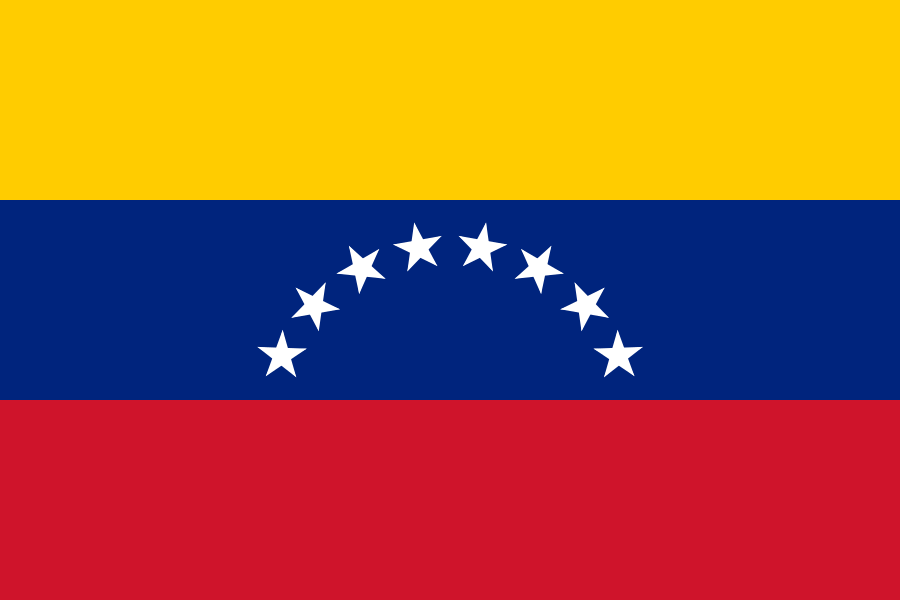
Welcome to Venezuela, a South American country home to dramatic tabletop mountains, the world's tallest waterfall, and a stunning Caribbean coastline. Angel Falls plunges dramatically from a towering tepui deep within Canaima National Park, a UNESCO World Heritage Site. Caracas, the capital, sits framed by mountains, blending vibrant culture with a dramatic natural backdrop. Venezuela's Los Roques archipelago offers pristine white-sand islands and turquoise waters largely undiscovered by mass tourism. The Gran Sabana's otherworldly tepuis create a landscape unlike anywhere else on Earth. Venezuela's Andean highlands offer cooler mountain scenery and traditional villages far from the tropical coast. Traditional joropo music and dance reflect the country's vibrant cultural heritage. Venezuela invites the most adventurous travelers to discover extraordinary natural wonders across dramatically varied terrain.

No API URL found for post ID 140620.
Helpful information to consider before and during your visit.
Discover some of Venezuela's most popular flavors, traditional dishes and memorable local treats during your visit.
Arepas is a well-known part of Venezuela's cuisine and offers visitors a flavorful introduction to the country's food traditions.
Pabellón Criollo is a well-known part of Venezuela's cuisine and offers visitors a flavorful introduction to the country's food traditions.
Hallacas is a well-known part of Venezuela's cuisine and offers visitors a flavorful introduction to the country's food traditions.
Cachapas is a well-known part of Venezuela's cuisine and offers visitors a flavorful introduction to the country's food traditions.
Asado Negro is a well-known part of Venezuela's cuisine and offers visitors a flavorful introduction to the country's food traditions.
Empanadas Venezolanas is a well-known part of Venezuela's cuisine and offers visitors a flavorful introduction to the country's food traditions.
Tequeños is a well-known part of Venezuela's cuisine and offers visitors a flavorful introduction to the country's food traditions.
Patacón Maracucho is a well-known part of Venezuela's cuisine and offers visitors a flavorful introduction to the country's food traditions.
Quesillo is a well-known part of Venezuela's cuisine and offers visitors a flavorful introduction to the country's food traditions.
Vietnam is home to Sơn Đoòng, the largest known cave passage in the world by volume, discovered relatively recently and found to be so massive that it contains its own localized weather system, complete with clouds forming inside the cave and a dense jungle growing on its floor where sunlight breaks through collapsed sections of the ceiling. The country's Hạ Long Bay features thousands of limestone karst islands and islets rising dramatically out of emerald waters, a landscape shaped over millions of years and recognized as a UNESCO World Heritage Site.
Vietnam endured a prolonged and devastating war in the mid-20th century, and the extensive Củ Chi tunnel network near Ho Chi Minh City, stretching over a hundred miles, allowed Viet Cong fighters to move troops, supplies, and even entire field hospitals underground largely undetected. The country has since transformed into one of the fastest-growing economies in Southeast Asia, and it's now one of the largest exporters of coffee in the world, a legacy tied back to French colonial-era plantation agriculture.
Vietnam's cuisine, particularly dishes like phở and bánh mì, reflects a distinctive blend of indigenous Vietnamese ingredients with French colonial culinary influence, creating a food culture widely celebrated around the world today.
Another little-known fact is that Albanians have a unique cultural tradition called "Besa," meaning "to keep one's promise." This centuries-old code of honor became internationally recognized during World War II when Albania was one of the few European countries where the Jewish population actually increased because local families risked their lives to shelter refugees. Albania also boasts the stunning Blue Eye (Syri i Kaltër), a natural spring with crystal-clear turquoise water whose exact depth remains unknown despite multiple explorations.
Finally, Albania enjoys more than 300 sunny days each year, rivaling many Mediterranean destinations. The country is also famous for its "sworn virgins"—a centuries-old tradition in remote mountain villages where women could legally assume male social roles by taking a lifelong vow of celibacy, preserving family inheritance and leadership in the absence of male heirs.