
Before You Go
- Confirm passport validity and entry requirements.
- Check whether a tourist visa is required.
- Keep digital copies of important documents.
- Consider purchasing travel insurance.
Bucharest
Romanian Leu (RON)
Romanian
May–Jun and Sep
EET (UTC+2) / EEST (UTC+3)
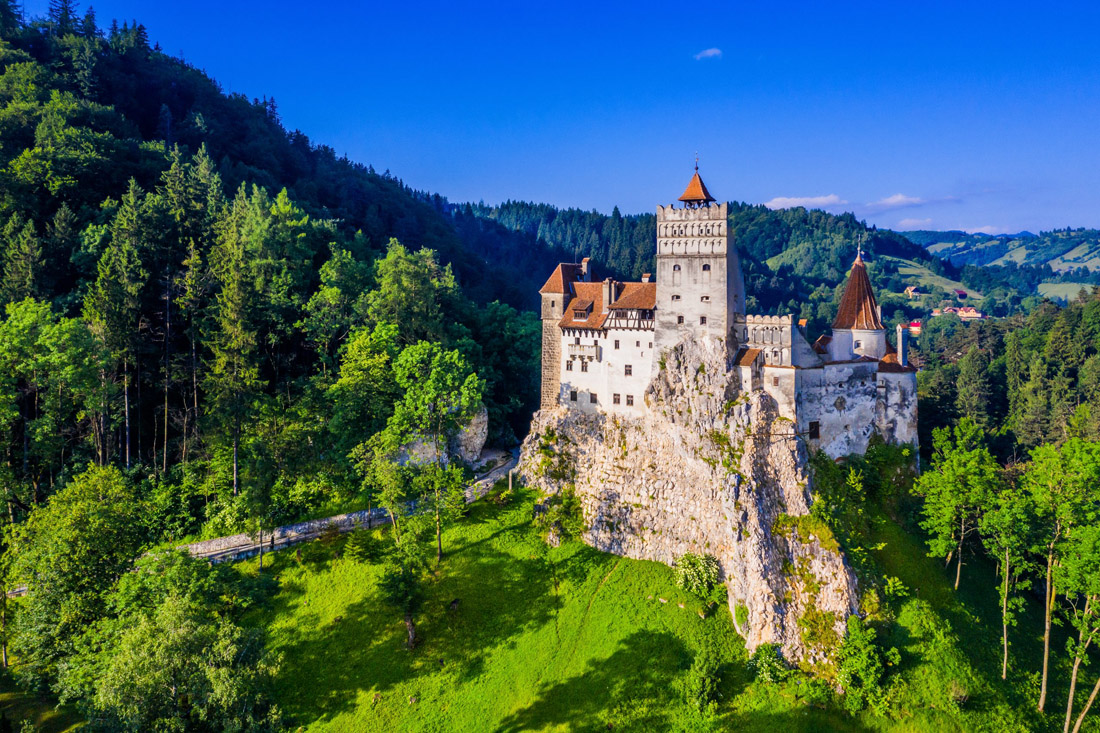
Welcome to Romania, a country where medieval castles, dense forests, and dramatic Carpathian peaks create a landscape steeped in legend. Bran Castle, famously linked to the Dracula legend, rises dramatically above the Transylvanian countryside. Bucharest, the capital, blends grand belle époque architecture with a lively, modern urban energy. The Carpathian Mountains offer excellent hiking, wildlife spotting, and remote villages seemingly untouched by time. Transylvania's fortified churches and medieval towns, including Sighișoara, reveal centuries of Saxon heritage. The Danube Delta, a UNESCO World Heritage Site, teems with extraordinary birdlife across its wetland channels. Traditional wooden villages in Maramureș preserve folk customs, crafts, and rural life dating back generations. Romania invites travelers to discover a country of legend, history, and dramatic natural beauty.

Helpful information to consider before and during your visit.
Discover some of Romania's most popular flavors, traditional dishes and memorable local treats during your visit.
Sarmale is a signature Romania specialty known for its distinctive local ingredients, seasoning and traditional preparation.
This popular Romania dish brings together familiar regional flavors and is commonly enjoyed in homes, markets or local restaurants.
A well-loved part of Romania cuisine, Ciorbă de Burtă reflects the country's culinary traditions and locally available ingredients.
Mici is a comforting regional favorite, prepared in styles that may vary between families, cities and different parts of Romania.
Visitors often seek out Tochitură for an authentic taste of Romania's everyday cooking and food culture.
This traditional favorite highlights the bold, savory or gently spiced flavors associated with cooking in Romania.
Cozonac is widely recognized in Romania and is often served at casual meals, celebrations or community gatherings.
A memorable choice for travelers, Salată de Boeuf offers a flavorful introduction to the ingredients and techniques used across Romania.
This classic food is an important part of Romania's culinary identity and is best sampled freshly prepared.
Romania is home to the historical region of Transylvania, whose dramatic castles and dense forests inspired the setting of Bram Stoker's Dracula, and Bran Castle, often marketed to tourists as "Dracula's Castle," draws visitors from around the world despite having only a loose historical connection to Vlad the Impaler, the 15th-century ruler often cited as a partial inspiration for the fictional count. Romania is also home to the Palace of the Parliament in Bucharest, the heaviest building in the world and one of the largest administrative buildings on Earth, built under the communist dictator Nicolae Ceaușescu at enormous cost to the country.
The country contains a significant portion of the Carpathian Mountains, which host one of the largest populations of brown bears, wolves, and lynx remaining in Europe, since Romania's forests were left comparatively undisturbed for decades under communist-era land policies. Romania is also home to the Danube Delta, one of the best-preserved river deltas in Europe and a UNESCO-protected wetland that supports an extraordinary diversity of bird species.
Romanian is a Romance language, closely related to Italian, French, and Spanish, despite Romania's location in Eastern Europe surrounded largely by Slavic-speaking neighbors, a linguistic legacy of the region's ancient Roman colonization.