
Before You Go
- Confirm passport validity and entry requirements.
- Check whether a tourist visa is required.
- Keep digital copies of important documents.
- Consider purchasing travel insurance.
Khartoum
Sudanese Pound (SDG)
Arabic, English
Nov–Feb
CAT (UTC+2)
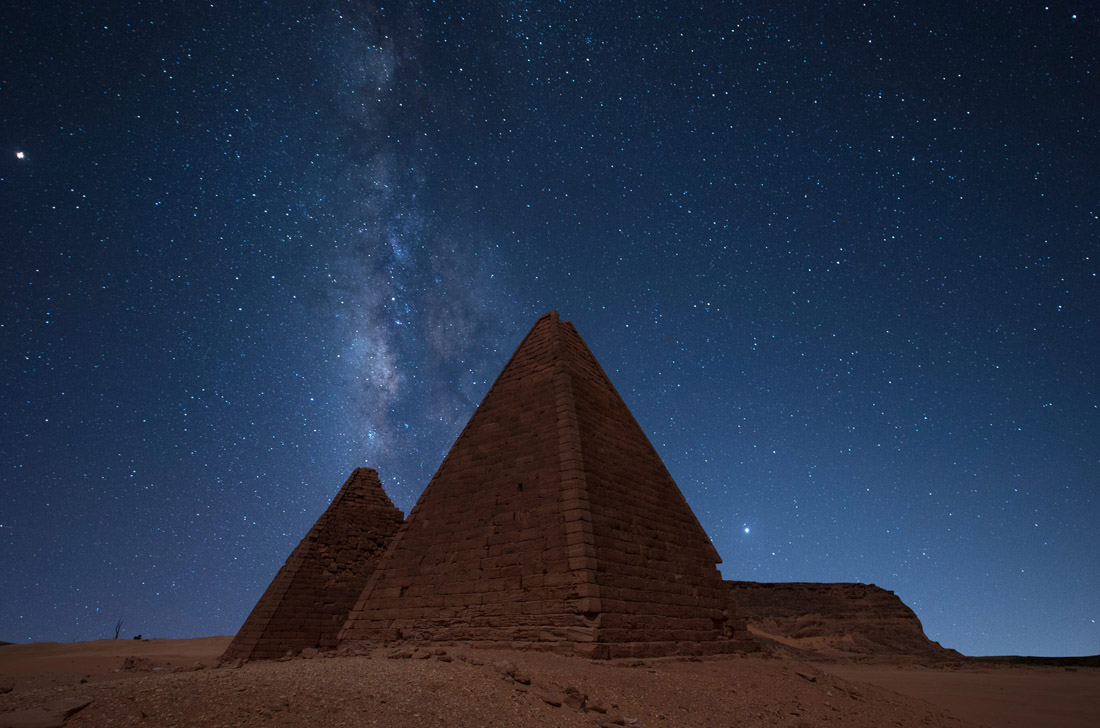
Welcome to Sudan, a country home to more ancient pyramids than Egypt, rising dramatically from the desert along the Nile River. The pyramids of Meroë, a UNESCO World Heritage Site, offer a remarkably uncrowded glimpse into the ancient Kingdom of Kush. Khartoum, the capital, sits at the dramatic confluence of the Blue and White Nile rivers. Sudan's vast deserts reveal remote archaeological sites largely untouched by modern tourism. Traditional Nubian villages along the Nile preserve distinct customs, colorful architecture, and deep historical roots. The Red Sea coast offers pristine coral reefs and diving largely undiscovered by international travelers. Sudan's ancient history rivals its northern neighbor, offering profound discovery with far fewer crowds. Sudan invites the most adventurous travelers to discover extraordinary ancient wonders along the Nile.

Helpful information to consider before and during your visit.
Discover some of Sudan's most popular flavors, traditional dishes and memorable local treats during your visit.
Ful Medames is a well-known part of Sudan's cuisine and offers visitors a flavorful introduction to the country's food traditions.
Kisra is a well-known part of Sudan's cuisine and offers visitors a flavorful introduction to the country's food traditions.
Asida is a well-known part of Sudan's cuisine and offers visitors a flavorful introduction to the country's food traditions.
Mullah is a well-known part of Sudan's cuisine and offers visitors a flavorful introduction to the country's food traditions.
Goraasa is a well-known part of Sudan's cuisine and offers visitors a flavorful introduction to the country's food traditions.
Shahan Ful is a well-known part of Sudan's cuisine and offers visitors a flavorful introduction to the country's food traditions.
Kajaik is a well-known part of Sudan's cuisine and offers visitors a flavorful introduction to the country's food traditions.
Tamia is a well-known part of Sudan's cuisine and offers visitors a flavorful introduction to the country's food traditions.
Basbousa is a well-known part of Sudan's cuisine and offers visitors a flavorful introduction to the country's food traditions.
Sudan is home to more pyramids than any other country on Earth, including Egypt, with the ancient Nubian kingdom of Kush having built over 200 pyramids near Meroë, though smaller and steeper than their more famous Egyptian counterparts, and far less visited despite their remarkable historical significance. The country was once home to the powerful Kingdom of Kush, which at one point conquered and ruled over Egypt itself as its 25th dynasty, a reversal of the more commonly known historical direction of influence.
Sudan sits at the confluence of the Blue Nile and White Nile in its capital, Khartoum, where the two rivers, visibly different in color, merge to form the Nile River proper before continuing north through Egypt to the Mediterranean. Historically one of the largest countries in Africa by land area, Sudan split in 2011 when South Sudan seceded following a lengthy civil conflict, reducing its territory significantly while it retained the bulk of the shared population's historical Arabic-Islamic cultural identity in the north.
Sudan has faced significant ongoing conflict and humanitarian crises in recent years, but its ancient Nubian archaeological sites, largely overshadowed by Egypt's more famous monuments, remain a rich and comparatively unexplored resource for historians and archaeologists.