
Before You Go
- Confirm passport validity and entry requirements.
- Check whether a tourist visa is required.
- Keep digital copies of important documents.
- Consider purchasing travel insurance.
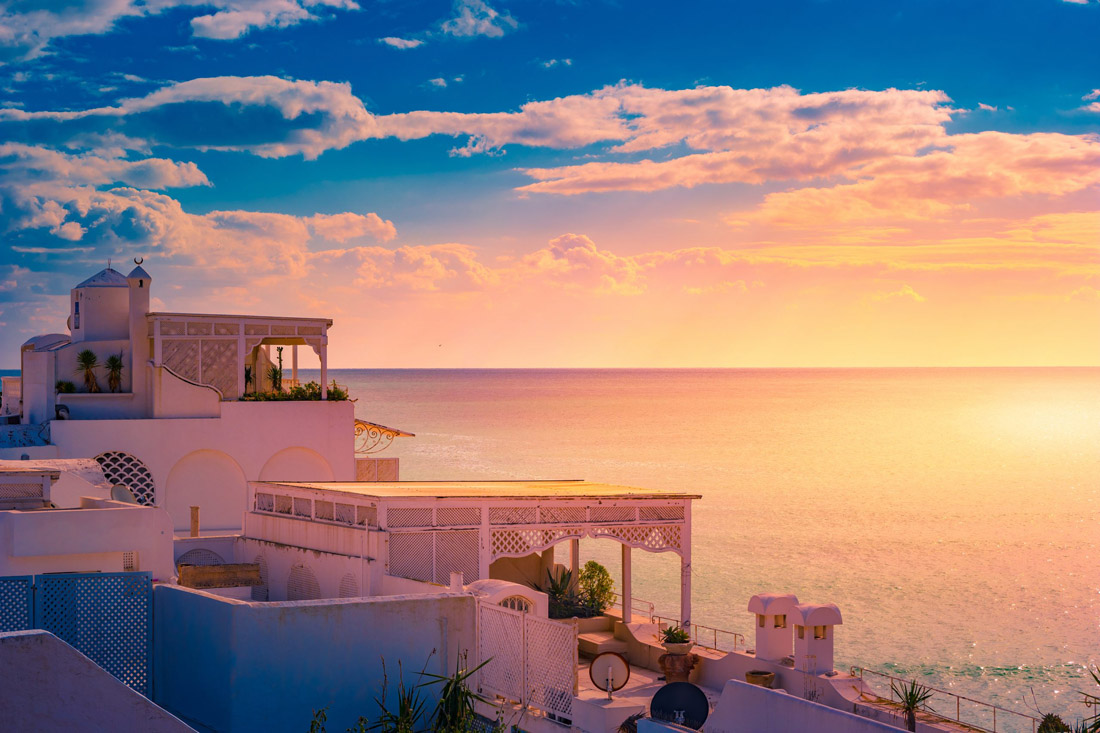
Tunis
Tunisian Dinar (TND)
Arabic
MarโMay and SepโNov
CET (UTC+1)
Welcome to Tunisia, a North African country where ancient Roman ruins, Mediterranean beaches, and Sahara dunes create striking diversity. The ruins of Carthage, once a great ancient empire, reveal centuries of Roman and Phoenician history near modern Tunis. Sidi Bou Said's blue-and-white streets offer one of the most picturesque towns on the Mediterranean coast. Tunisia's Sahara Desert, including the dramatic dunes near Douz, offers camel treks and star-filled desert camping. The ancient amphitheater of El Jem, among the best preserved in the world, rivals Rome's Colosseum in scale. Tunisia's coastline offers golden beaches and charming coastal towns along the Mediterranean Sea. Traditional souks in Tunis and Sousse showcase vibrant textiles, ceramics, and centuries-old craftsmanship. Tunisia invites travelers to discover a country where ancient history meets Mediterranean and desert beauty.

Helpful information to consider before and during your visit.
Discover some of Tunisia's most popular flavors, traditional dishes and memorable local treats during your visit.
Couscous is a well-known part of Tunisia's cuisine and offers visitors a flavorful introduction to the country's food traditions.
Brik is a well-known part of Tunisia's cuisine and offers visitors a flavorful introduction to the country's food traditions.
Lablabi is a well-known part of Tunisia's cuisine and offers visitors a flavorful introduction to the country's food traditions.
Ojja is a well-known part of Tunisia's cuisine and offers visitors a flavorful introduction to the country's food traditions.
Mechouia Salad is a well-known part of Tunisia's cuisine and offers visitors a flavorful introduction to the country's food traditions.
Kamounia is a well-known part of Tunisia's cuisine and offers visitors a flavorful introduction to the country's food traditions.
Mloukhia is a well-known part of Tunisia's cuisine and offers visitors a flavorful introduction to the country's food traditions.
Makroudh is a well-known part of Tunisia's cuisine and offers visitors a flavorful introduction to the country's food traditions.
Bambalouni is a well-known part of Tunisia's cuisine and offers visitors a flavorful introduction to the country's food traditions.
Tunisia is home to the ancient ruins of Carthage, once one of the most powerful cities in the ancient Mediterranean world and the base from which the legendary general Hannibal launched his famous campaign across the Alps against Rome, before Carthage was ultimately destroyed by Roman forces in 146 BCE. The country is also home to significant portions of the Sahara Desert, and its town of Matmata contains distinctive underground troglodyte dwellings carved directly into the earth, structures so visually striking that they were used as filming locations for the Star Wars films' Tatooine scenes.
Tunisia was the birthplace of the Arab Spring, with protests sparked in December 2010 following the self-immolation of a street vendor eventually toppling the country's longtime president and setting off a wave of pro-democracy uprisings across much of the Arab world. The country is also home to El Djem, an enormous Roman amphitheater nearly as large as Rome's Colosseum, remarkably well-preserved despite being located in a relatively small provincial Tunisian town rather than a major imperial capital.
Tunisia has historically been considered one of the more progressive countries in the Arab world regarding women's rights, having banned polygamy and granted women significant legal protections as early as 1956, shortly after gaining independence from France.