
Before You Go
- Confirm passport validity and entry requirements.
- Check whether a tourist visa is required.
- Keep digital copies of important documents.
- Consider purchasing travel insurance.
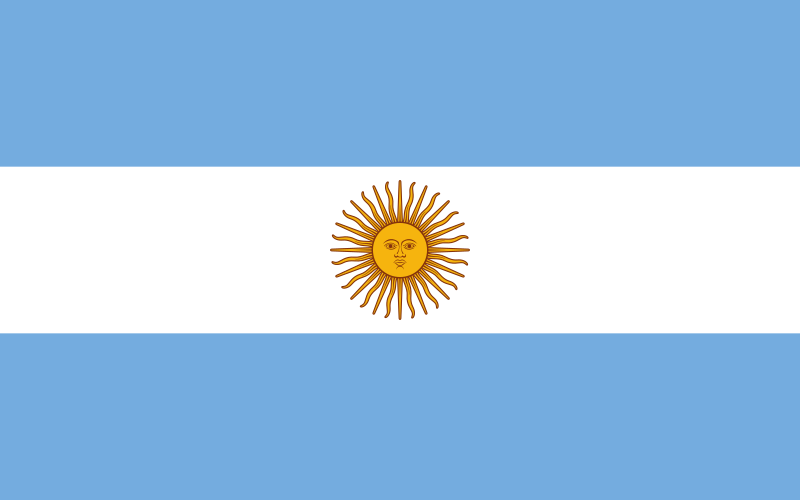
Buenos Aires
Argentine Peso (ARS)
Spanish
Oct–Apr
ART (UTC−3)
Welcome to Argentina, a country of staggering scale and diversity, stretching from the subtropical wetlands of the north to the glacier-carved fjords of Patagonia in the south. Buenos Aires captivates with its European elegance, tango-filled streets, and passionate energy that never seems to fade, day or night. In the west, Mendoza's sun-drenched vineyards produce world-renowned Malbec against a stunning backdrop of the snow-capped Andes. Further south, Bariloche enchants visitors with alpine lakes, dense forests, and chocolate-scented streets reminiscent of the Swiss Alps. At the very tip of the continent, Ushuaia, the "End of the World," offers rugged adventure amid glaciers, mountains, and the wild beauty of Tierra del Fuego. Argentina's landscapes are matched only by the warmth of its people, whose passion for life shows in their food, music, and traditions. From dramatic waterfalls to windswept steppe, this is a country built for explorers seeking both beauty and soul. Argentina welcomes you to experience a land where nature and culture meet in spectacular fashion.

No API URL found for post ID 140436.
Helpful information to consider before and during your visit.
Discover some of Argentina's most popular flavors, traditional dishes and memorable local treats during your visit.
Savory pastries filled with seasoned beef, chicken, cheese or vegetables, with recipes and folding styles that vary across Argentina.
Argentina’s famous barbecue features beef, sausages and other meats slowly grilled over wood or charcoal and shared with family and friends.
A grilled chorizo sausage served in crusty bread and commonly topped with chimichurri, creating a popular street-food favorite.
A thin breaded cutlet of beef or chicken, fried or baked and often served with potatoes, salad or melted cheese and tomato sauce.
A thick, comforting stew made with corn, beans, squash and meat, traditionally enjoyed during national celebrations and cooler weather.
A round of provolone cheese grilled until bubbling and golden, then seasoned with herbs and served as a warm appetizer.
Soft potato dumplings served with tomato, cream or meat sauces, especially popular on the twenty-ninth day of each month.
Tender sandwich cookies filled with dulce de leche and often coated with chocolate, powdered sugar or coconut.
Smooth caramel custard is commonly served with a generous spoonful of Argentina’s rich, creamy milk-caramel spread.
Despite being the birthplace of football legends like Diego Maradona and Lionel Messi, Argentina's official national sport isn't soccer at all — it's pato, a startling hybrid of polo and basketball played on horseback. The name literally means "duck" in Spanish, a nod to the sport's origins, when a live duck sewn into a leather sack was used in place of a ball. The game was so violent in its early form that it was repeatedly banned over the centuries before being tamed, regulated, and officially declared Argentina's national sport in 1953.
Tucked deep in Patagonia is a surprising outpost of Welsh culture, thousands of miles from Wales itself. Beginning in the 1860s, Welsh settlers established a string of communities in the Chubut Valley, seeking a place to preserve their language and traditions outside British influence. Their legacy endures: an estimated tens of thousands of people in the region still identify as Patagonian Welsh today, and towns like Gaiman still host Welsh tea houses, chapels, and an annual Eisteddfod poetry and music festival, conducted partly in Welsh, on the far side of the world from where the tradition began.
Argentina also holds a quiet but significant place in the history of criminal justice. In 1892, in the coastal town of Necochea, police official Juan Vucetich used fingerprint evidence to solve a murder case, marking the first time in recorded history that a criminal conviction relied on fingerprint identification. The technique Vucetich pioneered went on to become a cornerstone of forensic science practiced by police forces around the world, all traced back to that single case on the Argentine coast.
Another little-known fact is that Albanians have a unique cultural tradition called "Besa," meaning "to keep one's promise." This centuries-old code of honor became internationally recognized during World War II when Albania was one of the few European countries where the Jewish population actually increased because local families risked their lives to shelter refugees. Albania also boasts the stunning Blue Eye (Syri i Kaltër), a natural spring with crystal-clear turquoise water whose exact depth remains unknown despite multiple explorations.
Finally, Albania enjoys more than 300 sunny days each year, rivaling many Mediterranean destinations. The country is also famous for its "sworn virgins"—a centuries-old tradition in remote mountain villages where women could legally assume male social roles by taking a lifelong vow of celibacy, preserving family inheritance and leadership in the absence of male heirs.