Blahface.com Uniting People Online

Capital

Phnom Penh

Currency

Cambodian Riel (KHR)

Language

Khmer

Best Time

Nov–Feb

Time Zone

ICT (UTC+7)

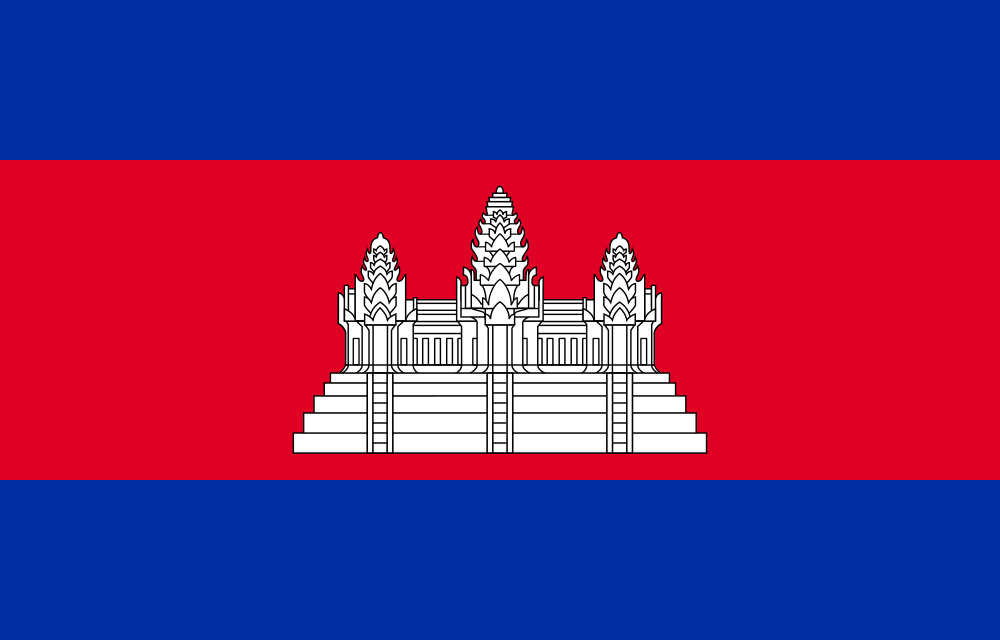
Flag of Cambodia
Welcome to Cambodia

Ancient Temples and Timeless Beauty

Welcome to Cambodia, a Southeast Asian country whose ancient temples and gentle spirit leave a lasting impression on every visitor. Angkor Wat, the largest religious monument in the world, rises majestically from the jungle near Siem Reap, a breathtaking testament to the Khmer Empire's golden age. Phnom Penh, the capital, blends French colonial architecture with bustling riverside markets and a resilient, evolving modern culture. Beyond Angkor, hundreds of lesser-known temples lie scattered throughout the countryside, many still wrapped in jungle vines and largely free of crowds. Cambodia's coastline offers pristine, lesser-known beaches and islands, perfect for travelers seeking a quieter tropical escape. The Tonlé Sap Lake, Southeast Asia's largest freshwater lake, is home to fascinating floating villages adapted to its dramatic seasonal changes. Traditional Khmer dance and vibrant local markets offer a rich cultural experience alongside the country's historic wonders. Cambodia welcomes travelers to explore a nation where ancient grandeur and warm hospitality go hand in hand.


Popular City

Phnom Penh

Phnom Penh’s Royal Palace, with its glittering Silver Pagoda floor made of solid silver tiles, remains the official residence of the Cambodian king and a symbol of the country’s enduring monarchy. The Tuol Sleng Genocide Museum, a former school turned Khmer Rouge prison, offers a harrowing but essential account of Cambodia’s tragic recent history. The National Museum houses one of the world’s finest collections of Khmer sculpture, spanning centuries of the empire that built Angkor Wat. The riverside promenade along the Tonle Sap and Mekong rivers offers a relaxed spot for an evening walk past food stalls and street performers. Central Market, housed in a striking Art Deco dome, sells gold, clothing, and street food beneath its distinctive yellow architecture. Phnom Penh’s blend of royal grandeur and sobering history makes it an essential stop for understanding modern Cambodia.

Travel News

No API URL found for post ID 140459.

Popular City

Siem Reap

Siem Reap serves as the gateway to Angkor Wat, the largest religious monument in the world and a UNESCO World Heritage site, best visited at sunrise when its five towers silhouette against the dawn sky. The wider Angkor Archaeological Park includes Angkor Thom’s Bayon temple, famous for its serene giant stone faces, and Ta Prohm, where massive tree roots entwine ancient ruins. Pub Street in the town center offers a lively strip of restaurants and bars catering to the steady flow of temple-bound visitors. Floating villages on the Tonle Sap Lake, reachable by boat from Siem Reap, offer a glimpse of communities that have adapted their entire way of life to the lake’s dramatic seasonal water level changes. The Angkor National Museum provides context on the Khmer Empire’s history and religious significance before or after visiting the temples themselves. Siem Reap’s proximity to Angkor makes it one of the most essential destinations in Southeast Asia.

Travel Tips

Helpful information to consider before and during your visit.

Before You Go

  • Confirm passport validity and entry requirements.
  • Check whether a tourist visa is required.
  • Keep digital copies of important documents.
  • Consider purchasing travel insurance.

Money & Payments

  • Review the local currency and exchange rate.
  • Carry some cash for small businesses and markets.
  • Check for international bank transaction fees.
  • Learn the country's customary tipping practices.

Stay Connected

  • Review your mobile carrier's international plan.
  • Consider purchasing a local SIM or eSIM.
  • Download maps for offline use before traveling.
  • Avoid sensitive transactions on unsecured Wi-Fi.

Transportation

  • Research public transportation before arrival.
  • Use licensed taxis or reputable rideshare services.
  • Check which side of the road vehicles use.
  • Confirm whether an international permit is needed.

Electricity

  • Check the country's voltage and outlet type.
  • Bring the correct plug adapter for your devices.
  • Use a voltage converter when required.
  • Pack a portable charger for longer excursions.

Weather & Clothing

  • Review the seasonal weather before packing.
  • Bring layers for changing temperatures.
  • Pack rain protection when appropriate.
  • Use sunscreen even on cool or cloudy days.

Food & Water

  • Research whether tap water is safe to drink.
  • Communicate food allergies clearly.
  • Try traditional dishes from reputable vendors.
  • Observe local dining customs and meal times.

Safety

  • Secure valuables in crowded tourist areas.
  • Avoid displaying large amounts of cash.
  • Share your itinerary with someone you trust.
  • Review current government travel advisories.

Language & Etiquette

  • Learn a few polite words in the local language.
  • Respect dress requirements at religious sites.
  • Ask permission before photographing people.
  • Follow local traditions, laws and social customs.

Emergency Planning

  • Save the country's emergency telephone number.
  • Locate your nearest embassy or consulate.
  • Keep medication in its original packaging.
  • Store emergency contacts offline and on paper.

Smart Packing

  • Pack comfortable shoes for walking and tours.
  • Keep essential medication in your carry-on.
  • Bring a reusable bottle where appropriate.
  • Leave room for locally purchased items.

Local Research

  • Check attraction hours and reservation policies.
  • Review national holidays and local closures.
  • Download important addresses before departure.
  • Leave flexibility for unexpected discoveries.
Important: Entry requirements, transportation rules, weather conditions and safety guidance can change. Verify important information with official sources before traveling.

Popular City

Battambang

Battambang, Cambodia’s second-largest city, retains some of the country’s best-preserved French colonial architecture along its riverside streets. The Bamboo Train, a makeshift bamboo platform powered by a small engine, offers a quirky, memorable ride along old rail lines through the countryside. Phare Ponleu Selpak, a circus school born from a refugee camp arts program, offers evening performances blending traditional Khmer storytelling with contemporary circus arts. Nearby, the killing caves of Phnom Sampeau add a sobering historical layer connected to the Khmer Rouge era, alongside a bat cave that releases millions of bats each evening at dusk. Battambang’s rural surroundings offer a quieter, more traditional look at Cambodian countryside life. Its blend of colonial architecture, contemporary arts, and difficult history make it a rewarding stop beyond the temples of Angkor.

Local Food to Try

Discover some of Cambodia's most popular flavors, traditional dishes and memorable local treats during your visit.

Fish Amok

Fish Amok is a signature Cambodia specialty known for its distinctive local ingredients, seasoning and traditional preparation.

Kuy Teav

This popular Cambodia dish brings together familiar regional flavors and is commonly enjoyed in homes, markets or local restaurants.

Lok Lak

A well-loved part of Cambodia cuisine, Lok Lak reflects the country's culinary traditions and locally available ingredients.

Nom Banh Chok

Nom Banh Chok is a comforting regional favorite, prepared in styles that may vary between families, cities and different parts of Cambodia.

Bai Sach Chrouk

Visitors often seek out Bai Sach Chrouk for an authentic taste of Cambodia's everyday cooking and food culture.

Samlor Korko

This traditional favorite highlights the bold, savory or gently spiced flavors associated with cooking in Cambodia.

Prahok Ktis

Prahok Ktis is widely recognized in Cambodia and is often served at casual meals, celebrations or community gatherings.

Num Krok

A memorable choice for travelers, Num Krok offers a flavorful introduction to the ingredients and techniques used across Cambodia.

Chek Ktis

This classic food is an important part of Cambodia's culinary identity and is best sampled freshly prepared.

Dining tip: Regional specialties and preparation styles vary throughout Cambodia. Explore local markets, independent cafés and family-owned restaurants for an authentic taste of the destination.

Little-Known Facts

Cambodia

Cambodia is home to Angkor, the vast former capital of the Khmer Empire and one of the largest preindustrial urban complexes ever built. Angkor Wat, its best-known temple, is the world’s largest religious monument and appears on Cambodia’s national flag. Originally dedicated to the Hindu god Vishnu, it gradually became a Buddhist site. The temple was designed with extraordinary astronomical and symbolic precision, and its five towers represent the peaks of sacred Mount Meru.

Beyond Angkor Wat, the ancient city contained an enormous network of reservoirs, canals, roads, temples, and neighborhoods. Modern aerial surveys have revealed that Angkor was far more extensive than previously understood. Cambodia’s Tonlé Sap Lake is equally unusual: during the rainy season, the Mekong River forces the Tonlé Sap River to reverse direction, causing the lake to expand dramatically and flood surrounding forests. When the water recedes, it supports one of the world’s most productive inland fisheries.

Cambodia is also known for the rare Irrawaddy dolphin, a round-headed freshwater dolphin that survives in small numbers along the Mekong. Traditional Khmer dance uses slow, precise movements and hand gestures, many of which carry symbolic meanings. The country’s famous krama, a checkered cotton scarf, can be worn as clothing, sun protection, a towel, a baby carrier, or even a hammock, making it one of Cambodia’s most practical cultural symbols.
Another little-known fact is that Albanians have a unique cultural tradition called "Besa," meaning "to keep one's promise." This centuries-old code of honor became internationally recognized during World War II when Albania was one of the few European countries where the Jewish population actually increased because local families risked their lives to shelter refugees. Albania also boasts the stunning Blue Eye (Syri i Kaltër), a natural spring with crystal-clear turquoise water whose exact depth remains unknown despite multiple explorations.

Finally, Albania enjoys more than 300 sunny days each year, rivaling many Mediterranean destinations. The country is also famous for its "sworn virgins"—a centuries-old tradition in remote mountain villages where women could legally assume male social roles by taking a lifelong vow of celibacy, preserving family inheritance and leadership in the absence of male heirs.