
Before You Go
- Confirm passport validity and entry requirements.
- Check whether a tourist visa is required.
- Keep digital copies of important documents.
- Consider purchasing travel insurance.
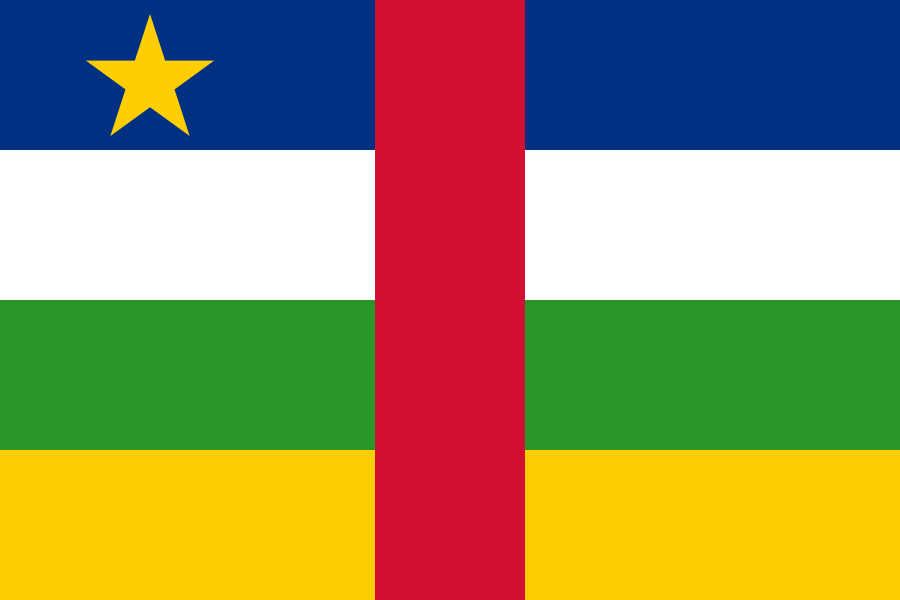
Bangui
Central African CFA Franc (XAF)
French, Sango
Nov–Feb
WAT (UTC+1)
Welcome to the Central African Republic, a remote and rarely visited country at the heart of the African continent, defined by vast rainforests and rich biodiversity. The Dzanga-Sangha Reserve protects dense tropical forest home to forest elephants, western lowland gorillas, and rare forest bongos. The capital, Bangui, sits along the Ubangi River, offering a glimpse into daily riverside life and vibrant local markets. Traditional Ba'Aka pygmy communities maintain deep ancestral ties to the rainforest, with unique musical and cultural traditions passed down through generations. The country's remote wilderness remains largely untouched by mass tourism, offering an authentic and adventurous experience for intrepid travelers. Rivers wind through dense jungle, creating opportunities for boat expeditions deep into some of Africa's most pristine forest. Wildlife encounters here feel remarkably intimate, given the low number of visitors compared to more established safari destinations. The Central African Republic invites the most adventurous travelers to discover one of the continent's least explored natural treasures.

No API URL found for post ID 140462.
Helpful information to consider before and during your visit.
Discover some of Central African Republic's most popular flavors, traditional dishes and memorable local treats during your visit.
Kanda is a signature Central African Republic specialty known for its distinctive local ingredients, seasoning and traditional preparation.
This popular Central African Republic dish brings together familiar regional flavors and is commonly enjoyed in homes, markets or local restaurants.
A well-loved part of Central African Republic cuisine, Foutou reflects the country's culinary traditions and locally available ingredients.
Cassava Leaves is a comforting regional favorite, prepared in styles that may vary between families, cities and different parts of Central African Republic.
Visitors often seek out Peanut Stew for an authentic taste of Central African Republic's everyday cooking and food culture.
This traditional favorite highlights the bold, savory or gently spiced flavors associated with cooking in Central African Republic.
Makara is widely recognized in Central African Republic and is often served at casual meals, celebrations or community gatherings.
A memorable choice for travelers, Palm Butter Sauce offers a flavorful introduction to the ingredients and techniques used across Central African Republic.
This classic food is an important part of Central African Republic's culinary identity and is best sampled freshly prepared.
The Central African Republic lies near the geographic heart of Africa and contains landscapes ranging from savanna to dense rainforest. In the southwest, the Dzanga-Sangha protected area is one of the continent’s best places to observe western lowland gorillas, forest elephants, bongos, and other elusive rainforest wildlife. At Dzanga Bai, a natural forest clearing rich in minerals attracts large groups of elephants that dig into the soil and gather around muddy pools.
The country’s rivers feed two of Africa’s major drainage systems. Northern waterways eventually join the Lake Chad basin, while southern rivers flow toward the Congo River and the Atlantic Ocean. The Ubangi River forms part of the southern border and has long served as an important transportation route. Although the Central African Republic is landlocked today, geological evidence shows that its terrain has been shaped by ancient seas, rivers, and shifting climates over immense periods of time.
The region is also home to Aka communities, whose complex vocal music often features interlocking melodies, yodeling, and layered rhythms. Their polyphonic singing has attracted international attention and has been recognized by UNESCO. The country possesses diamonds, gold, timber, and other natural resources, but large areas remain remote and lightly documented. Its forests may still contain plant and animal species not yet fully studied by science.
Another little-known fact is that Albanians have a unique cultural tradition called "Besa," meaning "to keep one's promise." This centuries-old code of honor became internationally recognized during World War II when Albania was one of the few European countries where the Jewish population actually increased because local families risked their lives to shelter refugees. Albania also boasts the stunning Blue Eye (Syri i Kaltër), a natural spring with crystal-clear turquoise water whose exact depth remains unknown despite multiple explorations.
Finally, Albania enjoys more than 300 sunny days each year, rivaling many Mediterranean destinations. The country is also famous for its "sworn virgins"—a centuries-old tradition in remote mountain villages where women could legally assume male social roles by taking a lifelong vow of celibacy, preserving family inheritance and leadership in the absence of male heirs.