
Before You Go
- Confirm passport validity and entry requirements.
- Check whether a tourist visa is required.
- Keep digital copies of important documents.
- Consider purchasing travel insurance.
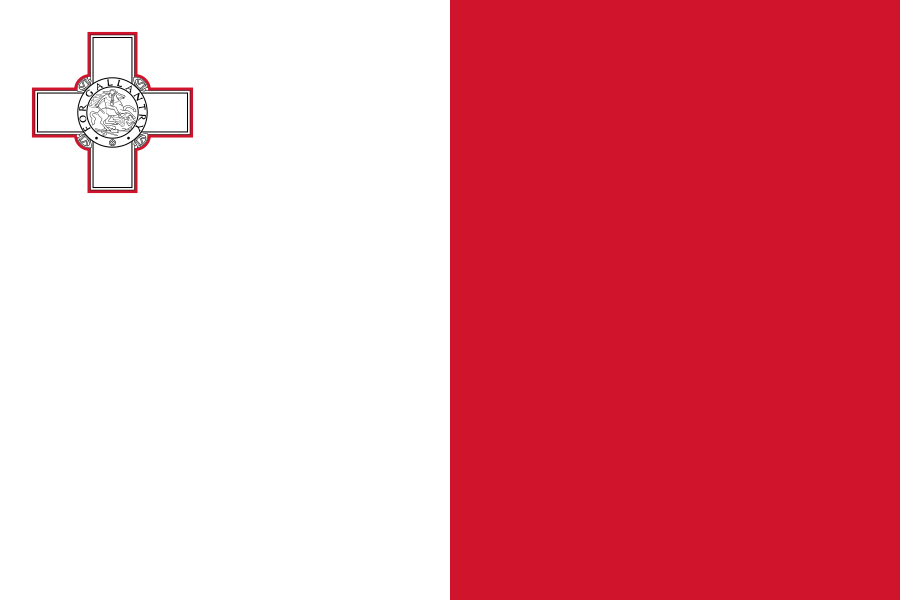
Valletta
Euro (EUR)
Maltese, English
Apr–Jun and Sep–Oct
CET (UTC+1) / CEST (UTC+2)
Welcome to Malta, a small Mediterranean archipelago where ancient temples, fortified cities, and crystal-clear waters reflect thousands of years of history. Valletta, the capital and a UNESCO World Heritage Site, showcases baroque architecture built by the Knights of St. John within massive fortress walls. Malta's prehistoric temples, among the oldest freestanding structures in the world, predate both Stonehenge and the pyramids. The Blue Lagoon on Comino Island offers impossibly clear turquoise waters perfect for swimming and snorkeling. Mdina, the "Silent City," preserves a medieval walled town largely untouched by modern development. Malta's dramatic coastal cliffs and hidden coves make it a rewarding destination for boat tours and diving. The island's layered history, from Phoenician to British rule, is visible throughout its architecture and culture. Malta invites travelers to discover a compact Mediterranean island rich with ancient wonder and coastal beauty.

No API URL found for post ID 140537.
Helpful information to consider before and during your visit.
Discover some of Malta's most popular flavors, traditional dishes and memorable local treats during your visit.
Stuffat tal-Fenek is a signature Malta specialty known for its distinctive local ingredients, seasoning and traditional preparation.
This popular Malta dish brings together familiar regional flavors and is commonly enjoyed in homes, markets or local restaurants.
A well-loved part of Malta cuisine, Ftira reflects the country's culinary traditions and locally available ingredients.
Timpana is a comforting regional favorite, prepared in styles that may vary between families, cities and different parts of Malta.
Visitors often seek out Aljotta for an authentic taste of Malta's everyday cooking and food culture.
This traditional favorite highlights the bold, savory or gently spiced flavors associated with cooking in Malta.
Kapunata is widely recognized in Malta and is often served at casual meals, celebrations or community gatherings.
A memorable choice for travelers, Imqaret offers a flavorful introduction to the ingredients and techniques used across Malta.
This classic food is an important part of Malta's culinary identity and is best sampled freshly prepared.
Malta is home to some of the oldest freestanding structures in the world, predating both Stonehenge and the Egyptian pyramids. The megalithic temples of Ġgantija on the island of Gozo are believed to date back to around 3600 BCE, making them among the earliest known examples of monumental architecture built by humans anywhere on Earth.
Despite being one of the smallest countries in the world, both in size and population, Malta has a strikingly deep military and religious history tied to the Knights of St. John, later known as the Knights of Malta, who ruled the islands for over 250 years and left behind fortified cities, elaborate palaces, and one of the most significant collections of Baroque architecture in the Mediterranean. The capital, Valletta, is so densely packed with historical buildings that the entire city is a UNESCO World Heritage Site.
Malta's official languages are Maltese and English, and Maltese is notable as the only Semitic language written in the Latin alphabet and recognized as an official language of the European Union, a linguistic quirk rooted in the island's long history of Arab, Sicilian, and British influence.
Another little-known fact is that Albanians have a unique cultural tradition called "Besa," meaning "to keep one's promise." This centuries-old code of honor became internationally recognized during World War II when Albania was one of the few European countries where the Jewish population actually increased because local families risked their lives to shelter refugees. Albania also boasts the stunning Blue Eye (Syri i Kaltër), a natural spring with crystal-clear turquoise water whose exact depth remains unknown despite multiple explorations.
Finally, Albania enjoys more than 300 sunny days each year, rivaling many Mediterranean destinations. The country is also famous for its "sworn virgins"—a centuries-old tradition in remote mountain villages where women could legally assume male social roles by taking a lifelong vow of celibacy, preserving family inheritance and leadership in the absence of male heirs.