Blahface.com Uniting People Online

Capital

Asunción

Currency

Paraguayan Guaraní (PYG)

Language

Spanish, Guaraní

Best Time

May–Sep

Time Zone

PYT (UTC−4)

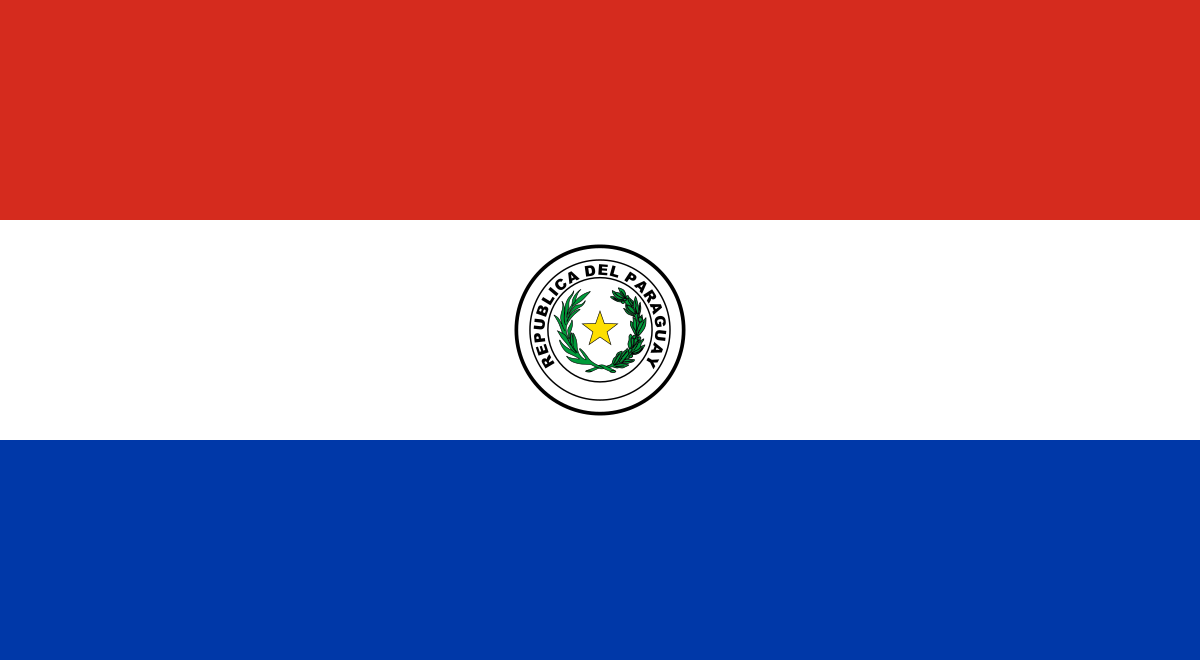
Flag of Paraguay
Welcome to Paraguay

Paraguay's Rivers and Jesuit Ruins

Welcome to Paraguay, a landlocked South American country where wide rivers, wetlands, and Jesuit ruins reveal a rich, understated history. Asunción, the capital, offers a relaxed introduction to Paraguayan culture along the banks of the Paraguay River. The Jesuit Missions of La Santísima Trinidad, a UNESCO World Heritage Site, reveal remarkably preserved colonial religious architecture. The Pantanal and Paraguayan Chaco offer vast wetlands and dry forest teeming with wildlife, including jaguars and giant anteaters. Paraguay's guaraní culture and language remain deeply woven into daily life, distinguishing it from its South American neighbors. Traditional ñandutí lace-making showcases intricate craftsmanship passed down through generations. The country's slower pace and lesser-visited status offer an authentic, uncrowded South American experience. Paraguay invites travelers to discover a quietly rich country full of history and natural beauty.


Popular City

Asuncion

Asuncion, one of the oldest cities in South America, mixes colonial-era buildings like the Palacio de los Lopez, the seat of government overlooking the Paraguay River, with a relaxed riverside promenade. The Panteon Nacional de los Heroes honors Paraguay’s independence leaders in a domed neoclassical building at the city’s center. The Manzana de la Rivera, a complex of restored historic houses, traces the city’s colonial and republican history through several small museums. Mercado 4, one of the city’s largest markets, offers a lively look at everyday Paraguayan commerce and street food. Asuncion’s relaxed pace and riverside setting give it a distinctly unhurried character among South American capitals. It serves as a practical base for exploring Paraguay’s Jesuit missions and countryside.

Travel News

No API URL found for post ID 140566.

Popular City

Ciudad del Este

Ciudad del Este, Paraguay’s second city, sits at the border with Brazil and Argentina, its massive duty-free shopping districts drawing cross-border shoppers from across the region. The nearby Itaipu Dam, one of the largest hydroelectric power plants in the world, offers tours explaining its massive scale and engineering. The Monday Falls, a series of cascades near the city, offer a quieter natural counterpart to the more famous Iguazu Falls just across the border. Ciudad del Este’s chaotic, commerce-driven energy reflects its role as a major hub of the tri-border trade region. The city serves as a convenient base for visiting Iguazu Falls from the Paraguayan side, avoiding some of the crowds found at the more visited Brazilian and Argentine entrances. Ciudad del Este offers a practical, if unpolished, gateway to one of South America’s most spectacular natural wonders.

Travel Tips

Helpful information to consider before and during your visit.

Before You Go

  • Confirm passport validity and entry requirements.
  • Check whether a tourist visa is required.
  • Keep digital copies of important documents.
  • Consider purchasing travel insurance.

Money & Payments

  • Review the local currency and exchange rate.
  • Carry some cash for small businesses and markets.
  • Check for international bank transaction fees.
  • Learn the country's customary tipping practices.

Stay Connected

  • Review your mobile carrier's international plan.
  • Consider purchasing a local SIM or eSIM.
  • Download maps for offline use before traveling.
  • Avoid sensitive transactions on unsecured Wi-Fi.

Transportation

  • Research public transportation before arrival.
  • Use licensed taxis or reputable rideshare services.
  • Check which side of the road vehicles use.
  • Confirm whether an international permit is needed.

Electricity

  • Check the country's voltage and outlet type.
  • Bring the correct plug adapter for your devices.
  • Use a voltage converter when required.
  • Pack a portable charger for longer excursions.

Weather & Clothing

  • Review the seasonal weather before packing.
  • Bring layers for changing temperatures.
  • Pack rain protection when appropriate.
  • Use sunscreen even on cool or cloudy days.

Food & Water

  • Research whether tap water is safe to drink.
  • Communicate food allergies clearly.
  • Try traditional dishes from reputable vendors.
  • Observe local dining customs and meal times.

Safety

  • Secure valuables in crowded tourist areas.
  • Avoid displaying large amounts of cash.
  • Share your itinerary with someone you trust.
  • Review current government travel advisories.

Language & Etiquette

  • Learn a few polite words in the local language.
  • Respect dress requirements at religious sites.
  • Ask permission before photographing people.
  • Follow local traditions, laws and social customs.

Emergency Planning

  • Save the country's emergency telephone number.
  • Locate your nearest embassy or consulate.
  • Keep medication in its original packaging.
  • Store emergency contacts offline and on paper.

Smart Packing

  • Pack comfortable shoes for walking and tours.
  • Keep essential medication in your carry-on.
  • Bring a reusable bottle where appropriate.
  • Leave room for locally purchased items.

Local Research

  • Check attraction hours and reservation policies.
  • Review national holidays and local closures.
  • Download important addresses before departure.
  • Leave flexibility for unexpected discoveries.
Important: Entry requirements, transportation rules, weather conditions and safety guidance can change. Verify important information with official sources before traveling.

Popular City

Encarnacion

Encarnacion, on the banks of the Parana River across from Argentina, has reinvented its waterfront with a long stretch of beaches and parks known as the Costanera, popular for swimming and recreation in the summer months. The city hosts one of Paraguay’s most vibrant Carnival celebrations each year. Nearby, the Jesuit ruins of Trinidad and Jesus de Tavarangue, both UNESCO World Heritage sites, preserve the remains of seventeenth-century missions built to educate and convert the region’s Guarani population. The ruins’ carved stone facades remain remarkably intact despite centuries of exposure. Encarnacion’s beach culture and access to the Jesuit missions make it one of Paraguay’s more appealing destinations beyond the capital. It offers a rare South American river beach experience alongside significant colonial history.

Local Food to Try

Discover some of Paraguay's most popular flavors, traditional dishes and memorable local treats during your visit.

Sopa Paraguaya

Sopa Paraguaya is a signature Paraguay specialty known for its distinctive local ingredients, seasoning and traditional preparation.

Chipa

This popular Paraguay dish brings together familiar regional flavors and is commonly enjoyed in homes, markets or local restaurants.

Mbejú

A well-loved part of Paraguay cuisine, Mbejú reflects the country's culinary traditions and locally available ingredients.

Bori Bori

Bori Bori is a comforting regional favorite, prepared in styles that may vary between families, cities and different parts of Paraguay.

Vori Vori

Visitors often seek out Vori Vori for an authentic taste of Paraguay's everyday cooking and food culture.

Pastel Mandi'o

This traditional favorite highlights the bold, savory or gently spiced flavors associated with cooking in Paraguay.

Pira Caldo

Pira Caldo is widely recognized in Paraguay and is often served at casual meals, celebrations or community gatherings.

Payagua Mascada

A memorable choice for travelers, Payagua Mascada offers a flavorful introduction to the ingredients and techniques used across Paraguay.

Dulce de Mamón

This classic food is an important part of Paraguay's culinary identity and is best sampled freshly prepared.

Dining tip: Regional specialties and preparation styles vary throughout Paraguay. Explore local markets, independent cafés and family-owned restaurants for an authentic taste of the destination.

Little-Known Facts

Paraguay

Peru is home to Machu Picchu, the 15th-century Inca citadel perched high in the Andes that remained unknown to the outside world until its rediscovery in 1911, despite being located just miles from Cusco, the former Inca capital. The country is also home to the Nazca Lines, enormous geoglyphs etched into the desert floor that depict animals and shapes so large they can only be fully appreciated from the air, and their exact purpose remains a subject of ongoing archaeological debate.

Peru is considered one of the birthplaces of the potato, with thousands of distinct potato varieties still cultivated in the Andean highlands today, far more than are commonly found anywhere else in the world. The country is also home to Lake Titicaca, the highest navigable lake in the world, shared with Bolivia, where the Uros people live on artificial floating islands constructed entirely from reeds, a practice that has continued for centuries.

Peru's coastline contains some of the driest deserts on Earth, yet the country simultaneously holds a significant share of the Amazon rainforest within its borders, giving it an extraordinarily diverse range of ecosystems packed within a single nation.
Another little-known fact is that Albanians have a unique cultural tradition called "Besa," meaning "to keep one's promise." This centuries-old code of honor became internationally recognized during World War II when Albania was one of the few European countries where the Jewish population actually increased because local families risked their lives to shelter refugees. Albania also boasts the stunning Blue Eye (Syri i Kaltër), a natural spring with crystal-clear turquoise water whose exact depth remains unknown despite multiple explorations.

Finally, Albania enjoys more than 300 sunny days each year, rivaling many Mediterranean destinations. The country is also famous for its "sworn virgins"—a centuries-old tradition in remote mountain villages where women could legally assume male social roles by taking a lifelong vow of celibacy, preserving family inheritance and leadership in the absence of male heirs.