Blahface.com Uniting People Online

Home Advertise Contact Terms

Capital

Dushanbe

Currency

Tajikistani Somoni (TJS)

Language

Tajik

Best Time

Mayโ€“Sep

Time Zone

TJT (UTC+5)

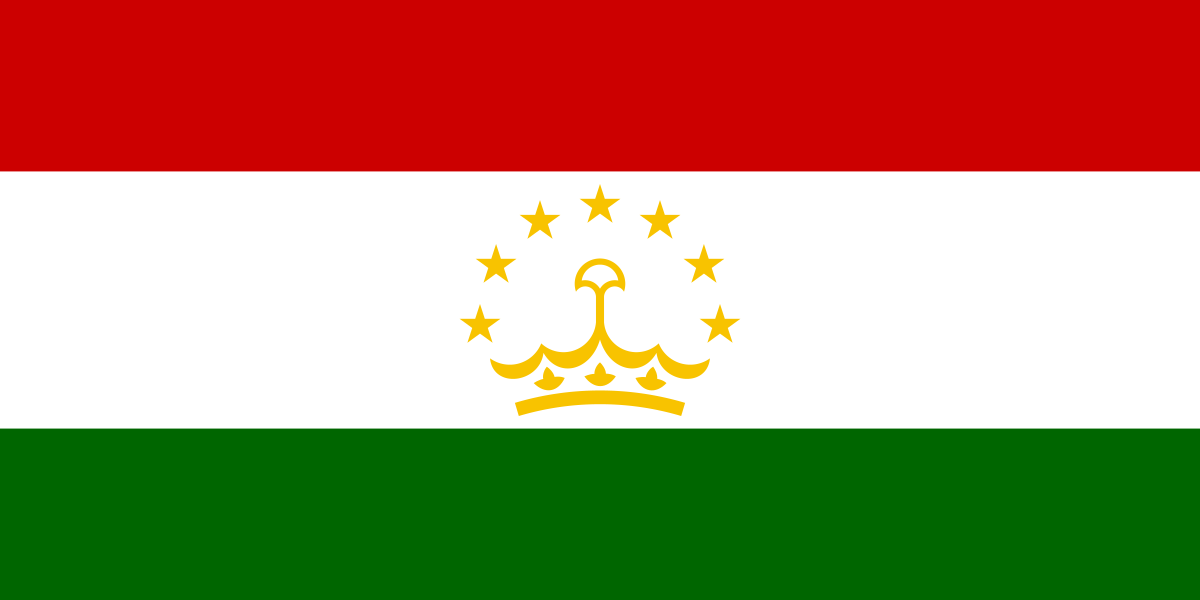
Flag of Tajikistan
Welcome to Tajikistan

Tajikistan's Roof of the World

Welcome to Tajikistan, a mountainous Central Asian country dominated by the towering Pamir Mountains, often called the "Roof of the World." The Pamir Highway offers one of the most dramatic high-altitude road journeys on Earth, winding past remote villages and turquoise lakes. Dushanbe, the capital, offers a relaxed introduction to Tajik culture amid tree-lined boulevards. Lake Iskanderkul, tucked into the Fann Mountains, offers stunning alpine scenery and legendary local folklore. Tajikistan's remote mountain villages preserve traditions of hospitality, music, and craftsmanship largely unchanged for centuries. The country's dramatic peaks, among the highest outside the Himalayas, offer world-class trekking and mountaineering. Silk Road history remains visible throughout the country's ancient trading towns. Tajikistan invites the most adventurous travelers to discover one of Central Asia's most dramatic mountain landscapes.


Popular City

Dushanbe

Dushanbe, Tajikistan’s green, tree-lined capital, is anchored by Rudaki Park and the National Museum of Antiquities, home to a striking seventeen-meter-long reclining Buddha statue recovered from an ancient Buddhist monastery site. The Somoni Monument, honoring the founder of the medieval Samanid dynasty, stands as a national symbol near the city center. The flagpole in Dushanbe once ranked among the tallest freestanding flagpoles in the world, a point of local pride. The city’s central bazaar offers dried fruits, nuts, and spices typical of Central Asian markets, alongside colorful traditional textiles. Dushanbe’s wide boulevards and fountains give the capital a relatively relaxed, orderly character. It serves as the essential gateway before heading into the dramatic Pamir Mountains further east.

Travel News

No API URL found for post ID 140600.

Popular City

Khujand

Khujand, one of the oldest cities in Central Asia, sits along the Syr Darya River and traces its history back to a fortress founded by Alexander the Great. The city’s Panjshanbe Bazaar, one of the largest and most vibrant markets in Tajikistan, has traded goods along Silk Road routes for centuries. The Khujand Fortress and adjoining museum offer context on the city’s role as a historic stronghold guarding the Fergana Valley. Local parks along the riverfront provide a relaxed contrast to the busy bazaar. Khujand’s deep Silk Road history and river setting give it a character distinct from the capital. It remains an important stop for travelers interested in Tajikistan’s ancient trading heritage.

Travel Tips

Helpful information to consider before and during your visit.

Before You Go

  • Confirm passport validity and entry requirements.
  • Check whether a tourist visa is required.
  • Keep digital copies of important documents.
  • Consider purchasing travel insurance.

Money & Payments

  • Review the local currency and exchange rate.
  • Carry some cash for small businesses and markets.
  • Check for international bank transaction fees.
  • Learn the country's customary tipping practices.

Stay Connected

  • Review your mobile carrier's international plan.
  • Consider purchasing a local SIM or eSIM.
  • Download maps for offline use before traveling.
  • Avoid sensitive transactions on unsecured Wi-Fi.

Transportation

  • Research public transportation before arrival.
  • Use licensed taxis or reputable rideshare services.
  • Check which side of the road vehicles use.
  • Confirm whether an international permit is needed.

Electricity

  • Check the country's voltage and outlet type.
  • Bring the correct plug adapter for your devices.
  • Use a voltage converter when required.
  • Pack a portable charger for longer excursions.

Weather & Clothing

  • Review the seasonal weather before packing.
  • Bring layers for changing temperatures.
  • Pack rain protection when appropriate.
  • Use sunscreen even on cool or cloudy days.

Food & Water

  • Research whether tap water is safe to drink.
  • Communicate food allergies clearly.
  • Try traditional dishes from reputable vendors.
  • Observe local dining customs and meal times.

Safety

  • Secure valuables in crowded tourist areas.
  • Avoid displaying large amounts of cash.
  • Share your itinerary with someone you trust.
  • Review current government travel advisories.

Language & Etiquette

  • Learn a few polite words in the local language.
  • Respect dress requirements at religious sites.
  • Ask permission before photographing people.
  • Follow local traditions, laws and social customs.

Emergency Planning

  • Save the country's emergency telephone number.
  • Locate your nearest embassy or consulate.
  • Keep medication in its original packaging.
  • Store emergency contacts offline and on paper.

Smart Packing

  • Pack comfortable shoes for walking and tours.
  • Keep essential medication in your carry-on.
  • Bring a reusable bottle where appropriate.
  • Leave room for locally purchased items.

Local Research

  • Check attraction hours and reservation policies.
  • Review national holidays and local closures.
  • Download important addresses before departure.
  • Leave flexibility for unexpected discoveries.
Important: Entry requirements, transportation rules, weather conditions and safety guidance can change. Verify important information with official sources before traveling.

Popular City

Khorog

Khorog, the gateway to the remote Pamir Mountains, sits in a dramatic valley along the Gunt River near the border with Afghanistan. The Pamir Botanical Garden, one of the highest-altitude botanical gardens in the world, showcases plant species adapted to the extreme mountain environment. The town serves as the starting point for journeys along the Pamir Highway, one of the world’s most dramatic high-altitude roads, winding through remote valleys and past turquoise lakes. Khorog’s markets reflect trade with neighboring Afghanistan, visible just across the narrow river valley. The surrounding Pamir region, often called the Roof of the World, offers some of Central Asia’s most spectacular and remote mountain scenery. Khorog rewards travelers seeking genuine high-altitude adventure far from more typical tourist routes.

Local Food to Try

Discover some of Tajikistan's most popular flavors, traditional dishes and memorable local treats during your visit.

Qurutob

Qurutob is a well-known part of Tajikistan's cuisine and offers visitors a flavorful introduction to the country's food traditions.

Osh

Osh is a well-known part of Tajikistan's cuisine and offers visitors a flavorful introduction to the country's food traditions.

Mantu

Mantu is a well-known part of Tajikistan's cuisine and offers visitors a flavorful introduction to the country's food traditions.

Shurbo

Shurbo is a well-known part of Tajikistan's cuisine and offers visitors a flavorful introduction to the country's food traditions.

Sambusa

Sambusa is a well-known part of Tajikistan's cuisine and offers visitors a flavorful introduction to the country's food traditions.

Lagman

Lagman is a well-known part of Tajikistan's cuisine and offers visitors a flavorful introduction to the country's food traditions.

Kabob

Kabob is a well-known part of Tajikistan's cuisine and offers visitors a flavorful introduction to the country's food traditions.

Fatir

Fatir is a well-known part of Tajikistan's cuisine and offers visitors a flavorful introduction to the country's food traditions.

Halvaitar

Halvaitar is a well-known part of Tajikistan's cuisine and offers visitors a flavorful introduction to the country's food traditions.

Dining tip: Regional specialties and preparation styles vary throughout Tajikistan. Explore local markets, independent cafรฉs and family-owned restaurants for an authentic taste of the destination.

Little-Known Facts

Tajikistan

Tanzania is home to Mount Kilimanjaro, the tallest mountain in Africa and the tallest freestanding mountain in the world, meaning it isn't part of a larger mountain range, rising dramatically straight up from the surrounding plains. The country also contains the Serengeti, home to one of the largest and most famous wildlife migrations on Earth, in which over a million wildebeest and hundreds of thousands of zebra move in a continuous seasonal cycle across the plains in search of fresh grazing.

Tanzania is home to Olduvai Gorge, often called the "Cradle of Mankind," where archaeologists have uncovered some of the most significant hominid fossils ever found, providing crucial evidence for the study of early human evolution over roughly two million years. The country also contains Zanzibar, an island archipelago with a rich history as a major historical hub of the spice trade, particularly cloves, and a complicated legacy tied to its role in the East African slave trade under Omani Arab rule before it merged with mainland Tanganyika to form modern Tanzania in 1964.

Tanzania is also home to Lake Tanganyika, the second-deepest freshwater lake in the world after Russia's Lake Baikal, holding an extraordinary diversity of fish species found nowhere else.
Another little-known fact is that Albanians have a unique cultural tradition called "Besa," meaning "to keep one's promise." This centuries-old code of honor became internationally recognized during World War II when Albania was one of the few European countries where the Jewish population actually increased because local families risked their lives to shelter refugees. Albania also boasts the stunning Blue Eye (Syri i Kaltรซr), a natural spring with crystal-clear turquoise water whose exact depth remains unknown despite multiple explorations.

Finally, Albania enjoys more than 300 sunny days each year, rivaling many Mediterranean destinations. The country is also famous for its "sworn virgins"โ€”a centuries-old tradition in remote mountain villages where women could legally assume male social roles by taking a lifelong vow of celibacy, preserving family inheritance and leadership in the absence of male heirs.